
 De Enlife Solutions and Alin Ladaru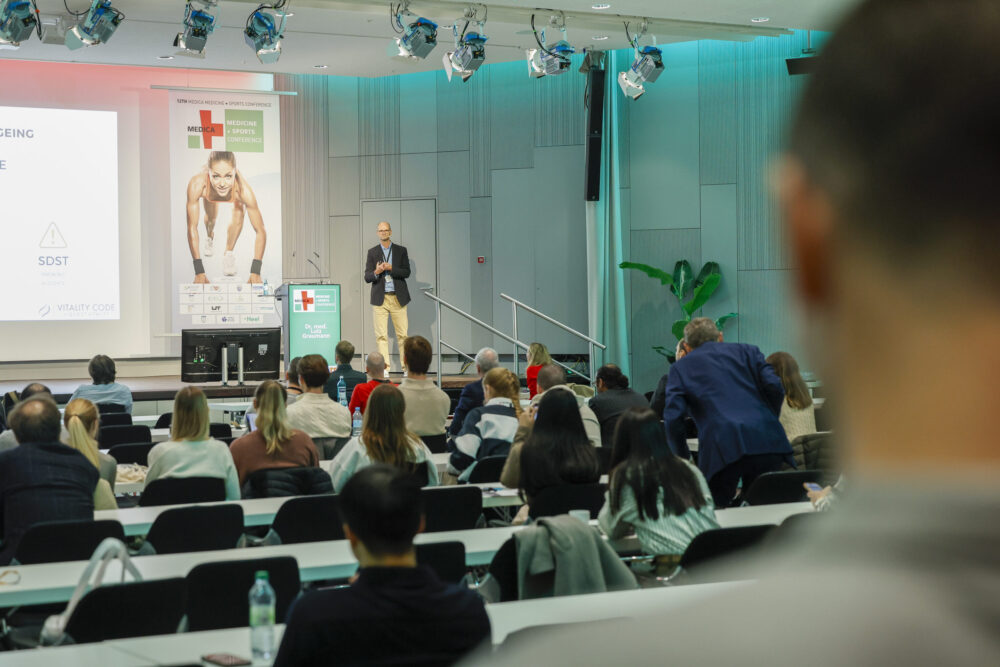
Author: Dr Lutz Retzlaff, Medica
Can weight loss injections replace exercise? Or is it better to combine the two? New treatments could be making it seem attractive to lose weight without strenuous exercise: they will be examined closely at the 13th MEDICA MEDICINE + SPORTS CONFERENCE. On 19 and 20 November 2025, the conference – an established feature of the leading international medical trade fair MEDICA in Düsseldorf (duration: 17 – 20 November) is set to be the hotspot for sports medicine, sports science and interested athletes. At the Congress Centre Düsseldorf (CCD Süd), renowned experts will give talks on hotly debated topics. These speakers will include: Dr Kerstin Holze, Vice President of the German Olympic Sports Confederation; bestselling author Thomas Schulz; Prof. Esa Räsänen, Head of the Department of Physics at the University of Tampere in Finland; sports physician Dr. Lutz Graumann, and Prof. Yannis Pitsiladis, Chairman of the Scientific Commission of the International Federation of Sports Medicine (FIMS). The handling of injectable drugs in sports medicine and sports science will be just one of many items on their agenda.

Improving health for a longer life is the topic right at the start of the conference, on 19 November from 1 p.m. The well-known bestselling author and journalist Thomas Schulz is well connected on the scene and worked in Silicon Valley for a long time. He is dedicated to extending lifespans and will be exploring the two following questions in his lecture: “In what ways are cutting-edge research and high-tech medicine already making one hundred healthy years of life possible – and what must we do to achieve this?”

The focus in Düsseldorf will be on scientifically and technologically sound strategies for a stronger cardiovascular system. Dr. Lutz Graumann will also be speaking on the subject of health and longevity. He is a recognised expert in the fields of sports medicine, nutritional medicine and chirotherapy – as well as being a longevity specialist. According to him, data points are not only there to fill dashboards, but also to provide meaningful insights into people’s cardiovascular health and performance; “Hand on heart – set up your own plan for a long cardiovascular life” is the title of his presentation at the Sports Medicine Conference at MEDICA 2025.


Prof. Dr. Esa Räsänen is not only head of the Department of Physics at the University of Tampere, Finland, he is also CEO and co-founder of Moni Cardi. The software developed by Moni Cardi can be integrated into any wearable device, including wristband monitors, bracelets, rings and clothing. It is designed to enable an accurate assessment of various heart conditions based on heart rate alone and to function as a versatile pre-diagnosis tool for effective treatment recommendations – even on the mass market. What Räsänen is therefore proposing is a suitable measurement for use after a variable heart rate has been determined.
So far, change in intervals between successive regular heartbeats has been regarded as the benchmark for the ability to adapt heart rate to physical and mental demands. Prof. Eric Schulze-Bahr, Director of the Institute for Genetics of Heart Diseases (IfGH) at Münster University Hospital, is one of the authors of the current guideline on genetic diagnostics for cardiovascular diseases. In a specialist publication, he pointed out that around half of sudden or unexplained deaths in children, adolescents or adults under the age of 40 – such as athlete deaths or unexpected deaths at night – could be caused by a genetic coronary disease such as cardiomyopathy or a congenital arrhythmia syndrome. These cases may be avoidable: “Sports meets cardiogenetics – cardiogenetics and sports” is the topic of his lecture.
Modern weight loss drugs in injection form are considered effective and are also becoming increasingly popular as lifestyle supplements. But how do these active ingredients affect performance? And what happens in the body when they are used? There have been multiple reports that the desired weight loss using these treatments may be accompanied by unwanted muscle atrophy. When that happens, those affected experience weight loss in the wrong places. Prof. Tim Hollstein, senior physician and head of the Department of Nutritional Medicine and research group leader at University Hospital Schleswig-Holstein in Kiel, will explain how this can be prevented. The title of his contribution to the 13th MEDICA MEDICINE + SPORTS CONFERENCE is: “Maintaining muscle while utilising next-generation weight loss treatments”.


Prof. Klara Brixius, Professor at the German Sport University in Cologne, is an expert on age-related muscle atrophy – many of the findings and recommendations from her research are transferable with regard to the prevention of muscle atrophy during drug treatment for weight loss. She will provide an insight into the right muscle-building exercise programmes to accompany this kind of treatment.
In Düsseldorf, Dr. Kay Niemier, head physician at the LUP Clinics pain and back pain centre, will explain how exercise therapy can also be used specifically to control weight loss and report on his experience with obesity patients. The link between fitness, body weight and diabetes is clear. For this reason, the German Diabetes Society is also a co-operation partner of the conference.
The “MEDICA Guided Innovation Tour” through the exhibition halls, where selected topics will be addressed and exhibiting companies visited, also has exciting topics in store for conference participants. The MEDICA SPORTS HUB (in Hall 4) and the WT Wearable Technologies Show (in Hall 12) are just two of the attractions. Professionals can test innovative sports and health equipment in practice in the expansive activity area in Hall 4. Partners include CTN from Finland. They offer devices for cryotherapy, hyperbaric oxygen therapy, muscle stimulation and red light therapy. NICE will also be there, with its ice-free cryotherapy for regeneration and performance enhancement. The Wearable Technologies Show in Hall 12, meanwhile, will be offering many innovative wearable technologies for monitoring vital and performance parameters.


The healthcare system is facing major changes: few people are meeting the World Health Organisation (WHO) guidelines for physical activity and the call for more prevention is growing ever louder. The 2nd day of the Sports Medicine Conference will start on 20 November with Session 4: “The crisis of physical inactivity – movement is medicine”. In this session, Prof. Yannis Pitsiladis, Chairman of FIMS, the umbrella organisation of all sports medicine associations, and Dr. Sven Messing, from the WHO Collaborating Centre for Physical Activity and Public Health at the University of Erlangen-Nuremberg, will present requirements and guidelines from leading alliances – for various phases of life and times of day. The advice applies to everything from exercise for children and young people, through fitness for companies and their employees to urban spaces.
Prevention should already begin at a young age. However, only around one third of children (27 to 33 per cent) achieve the World Health Organisation’s (WHO) recommended level of physical activity. In “The health of our young people: What needs to change, what can we do?”, Dr. Kerstin Holze explores that question. She is Vice-President of the German Olympic Sports Confederation (DOSB) and a specialist in paediatrics and adolescent medicine. The dedicated doctor is therefore acquainted with the challenges from multiple perspectives. Olympic sports can act as a role model and encourage more physical activity – but that alone is not enough. Prof. Norbert Bachl, founding president of the European Federation of Sports Medicine Associations (EFSMA) and Prof. Edmond Hajrizi, President of UBT University in Prishtina, use a working university campus as an example to show how university teachers and students can be motivated to get more exercise.


Under the “Active City!” label, the City of Hamburg aspires to activate an entire metropolis. From basketball to yoga, at the sports club or in the city park – there are numerous offerings in the individual neighbourhoods. A central portal (https://www.hamburg-activecity.de) pools all offerings and makes them easy to find according to interests on a large interactive city map. Christoph Hollstein, State Secretary for Sports at the Hamburg Ministry of the Interior and Sports, will present the “Active City!” concept at the MEDICA MEDICINE + SPORTS CONFERENCE. Hollstein himself cycles to work in all weathers and his city boasts the right infrastructure to motivate people to get moving.
“Data-driven strategies for peak performance and injury prevention” is the title of conference Session 5. It is dedicated to elite sports, including the future of disabled sports. Dr. Sebastian Rösler will be a speaker in the session. He works as a coach in elite sports and is co-founder of Pro Athletes. The company offers (data-supported) training advice, support and analysis, for example for cycling and running. Meanwhile, canoeing is a focus of the work of conference speaker Prof. Dr. Mirco Fuchs, Professor of Computer Vision and Machine Learning at Leipzig University of Applied Sciences. There, the individual movements of canoeists are analysed using video and artificial intelligence in order to optimise performance – for example, to optimise the water line for fast propulsion of the athlete’s movement – and prevent injuries. The new technologies make it possible to swiftly integrate knowledge from videos into active training.

Medical eConmerce & Consultacy Business

 Alexandra Panaitescu